
FSC and OPRL often appear in the same conversation about sustainable packaging, which makes it easy to treat them as variations on the same idea. They are not. FSC is mainly about where forest-based material comes from and how that material is tracked through the supply chain. OPRL is about giving consumers clear recycling instructions for packaging in the UK.
For an e-commerce packaging manager, that distinction is useful. A carton can use responsibly sourced fibre but still have features that make recycling more difficult. Equally, a pack can carry clear recycling instructions without those instructions telling you anything about the origin of its paper or board.
The sensible approach is to stop looking for one badge that proves a pack is 'sustainable'. There isn't one. FSC certification, OPRL labelling and the government's recyclability rules answer different questions, and the best specification decisions come from understanding what each one actually covers.
What FSC certification actually tells you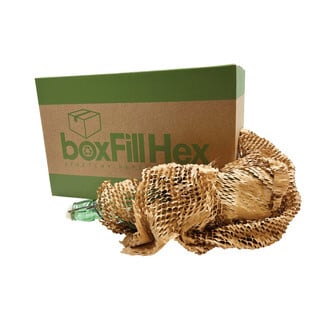
The Forest Stewardship Council (FSC) is a certification system for forest-based materials. FSC-certified forests are managed against environmental, social and economic standards, while FSC Chain of Custody certification tracks eligible material as it moves through processing, manufacturing and sale.
That chain-of-custody part matters for packaging procurement. If a supplier says a box is FSC certified, the useful follow-up is not simply 'great, can we put the logo on it?' You want to know what the claim applies to, which FSC claim the product carries and whether the supply chain is certified to make that claim.
FSC 100%, FSC Mix and FSC Recycled are not interchangeable
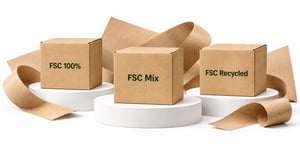
There are three main FSC labels, and they mean slightly different things. FSC 100% means the forest-based material comes from FSC-certified forests. FSC Recycled means the forest-based material has been verified as 100% recycled. FSC Mix can contain a mixture of FSC-certified material, recycled material and controlled wood.
None of those labels is a simple ranking from worst to best. Recycled fibre can be a very sensible choice for a transit carton, while virgin fibre from responsibly managed sources can be useful where the performance requirement calls for it. The point of the certification is traceability and responsible sourcing, not to tell an operations team which board grade will survive a courier network.
Allpack states that its box production uses FSC-certified board with up to 100% recycled paper, depending on the product. That makes FSC relevant when comparing corrugated packaging, but the normal specification questions still apply: board construction, product weight, dimensions, stacking, handling and the journey the parcel has to survive.
What FSC does not tell you
This is where sustainable packaging claims can get muddled. An FSC mark does not, by itself, tell you that a finished pack is recyclable at kerbside. It does not tell you that the box is right-sized. It does not tell you how much recycled content is present unless the specific claim says so. And it certainly does not tell you whether the product inside will arrive intact.
Imagine an FSC-certified carton with a difficult-to-separate plastic window, a laminated finish and an oversized interior packed with unnecessary filler. The fibre sourcing may be properly certified, but that does not make the whole packaging system a good one.
For e-commerce teams, FSC is therefore best used as one procurement criterion among several. It gives you evidence about forest-based sourcing. You still need to assess material efficiency, transit performance, recyclability and the practical fit with your packing operation.
So, what is OPRL?
OPRL stands for On-Pack Recycling Label. Its familiar recycling labels are designed to tell consumers what to do with individual packaging components after use.
That sounds straightforward, but there is an important distinction here too. OPRL itself says its labels are not a certification or endorsement of the recyclability of a pack. Members use OPRL's labelling rules and tools to determine the appropriate recycling instruction and communicate it consistently to consumers.
In practical terms, OPRL is the bit that helps the customer standing beside the recycling bin. FSC is much further upstream in the story.
OPRL labels work at component level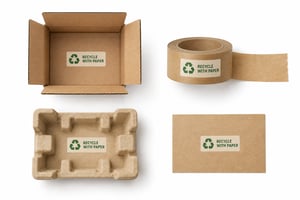
A parcel is rarely one material. There may be a corrugated box, tape, a paper insert, a label, protective material and perhaps a separate pouch or closure. OPRL's labelling process asks members to consider the components and materials used in the packaging, rather than treating the pack as one vague recyclable object.
That is a useful discipline even before a label is designed. If your team cannot clearly describe what each packaging component is made from and what the customer should do with it, the specification probably needs another look.
It also explains why switching one component can improve the pack as a whole. Moving from a conventional plastic parcel tape to an appropriate paper tape, for example, may simplify the material mix around a corrugated carton. Allpack's boxbond™ paper tape range is designed as a paper-based sealing option, with self-adhesive and water-activated formats available for different packing operations.
OPRL labelling is not currently the same thing as mandatory EPR labelling
This point is worth spelling out because the rules have moved around. The previously announced requirement for mandatory recycling labels on consumer packaging from 1 April 2027 was put on hold. OPRL's current guidance says mandatory recycling labelling is not included in the first stage of packaging EPR, although the government still intends to address mandatory labelling in future legislation.
So, as things stand in 2026, seeing an OPRL label on a pack should not be interpreted as proof that a business is simply complying with a universal 2027 labelling requirement. OPRL remains a voluntary labelling system used by members to communicate recycling information clearly, while the statutory EPR recyclability regime sits elsewhere.
For e-commerce teams, that does not make OPRL irrelevant. Quite the opposite. Clear disposal instructions are useful to customers, and a recognised labelling system can be more credible than inventing your own recycling icon and hoping everybody understands what it means.
Where RAM and EPR fit into the picture
The statutory side is increasingly important. Under Extended Producer Responsibility for packaging, obligated large producers must use the government's Recyclability Assessment Methodology, usually shortened to RAM, to assess the recyclability of household packaging and report the results.
For packaging supplied during 2026, large producers use RAM version 1.1. RAM 2027 applies to packaging supplied in the 2027 reporting year. It looks at what happens to packaging through real UK recycling infrastructure, including collection, sortation, reprocessing and whether the resulting recyclate has a viable application.
The final rating is red, amber or green, and those ratings feed into modulated EPR disposal fees. Less recyclable packaging can therefore become more expensive for obligated producers, which gives recyclability a direct procurement consequence rather than leaving it as a marketing claim.
There is another useful distinction here: PackUK explicitly states that RAM ratings are not the same thing as other recyclability labelling that may appear on packaging. An OPRL label communicates with the consumer. A RAM assessment is part of the producer's regulatory recyclability assessment. They may draw on similar questions about real-world recycling, but they are not interchangeable.
A better way to read sustainable packaging claims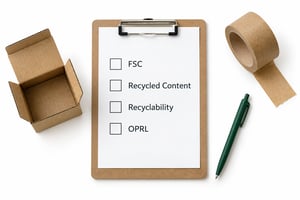
Packaging managers are now surrounded by claims: FSC certified, recycled, recyclable, plastic-free, compostable, kerbside recyclable, lower carbon. Some are backed by certification. Some are regulated environmental claims. Some are simply product descriptions.
Rather than asking whether a pack is sustainable, break the claim into something you can actually check.
- If it says FSC certified, what FSC claim does the product carry and does it apply to the packaging you are buying?
- If it says recycled, what percentage is recycled material and is that post-consumer, pre-consumer or a mixture?
- If it says recyclable, is that true of the complete pack in the form the customer is likely to discard it?
- If an OPRL label is being used, does the instruction match the individual packaging components?
- If the packaging is in scope for EPR recyclability reporting, what RAM rating does the current specification receive?
- If the supplier recommends a change, does it still meet the required transit and packing performance?
These questions are less glamorous than a sustainability badge, but they are much more useful when you are signing off a packaging specification that may be used for hundreds of thousands of orders.
Certification cannot rescue a bad pack
There is a slightly awkward truth in sustainable packaging: the pack still has to work.
A beautifully certified carton that is too weak for the product is wasteful. A recyclable mailer that causes more damaged orders is wasteful. A paper tape that is wrong for the carton surface and needs three strips instead of one may not be the improvement it first appeared to be.
That is why Allpack's sustainable packaging range is more useful when products are considered as part of the packing system. Corrugated boxes, paper tape, paper void fill and protective packaging all affect one another. The aim should be a pack that uses credible materials and survives the journey without quietly creating extra work at the packing bench.
For example, if a business is moving towards fibre-based packaging, Allpack's paper void fill range can be assessed alongside FSC-certified corrugated packaging and paper sealing options. That may simplify the material mix, but the right amount and type of protection still depends on the product.
What to ask a packaging supplier
A good supplier should be able to give you more than a sustainability adjective. If a claim matters to your procurement policy, customer communication or EPR reporting, ask for the evidence behind it.
- Which FSC claim applies to this product, and can you provide the relevant certification or chain-of-custody information?
- What recycled content is present, and how is that figure evidenced?
- What are the individual materials and components in the finished pack?
- Can the supplier explain how tape, coatings, labels or windows affect recyclability?
- Has the specification been considered against current RAM criteria where relevant?
- What recycling instruction should the customer receive?
- Can the supplier support an OPRL assessment, or provide the material data your team needs to complete one?
- What transit testing or performance information supports the packaging recommendation?
- If the specification changes, how will you be told?
That final question is easy to overlook. Certification and recyclability assessments depend on the actual material being supplied. A quiet change in coating, adhesive, board composition or component construction can matter if your own claims and reporting are based on the previous specification.
Use FSC, OPRL and RAM for the jobs they are good at
The simplest way to keep all of this straight is to give each framework a job.
Use FSC to understand and verify responsible sourcing of forest-based material. Use OPRL to communicate practical recycling instructions to customers. Use RAM, where your business is obligated to do so, to assess recyclability for EPR reporting and fee modulation.
Then put those answers back into the wider packaging decision. Does the pack fit the product? Does it survive transit? Is it efficient to pack? Is the material use sensible? Can your supplier support it at the volume you need?
That gives you a much stronger basis for a sustainable packaging claim than collecting logos. The certifications and labels matter, but what matters more is knowing exactly what they prove.
Get in Touch
If you're reviewing your packaging specifications and want to make sense of FSC-certified materials, recyclability, paper alternatives or the wider sustainability picture, the Allpack team can help.
We can support you with FSC-certified corrugated packaging, boxbond™ paper tape, paper void fill and other packaging options, while helping you keep product protection and packing efficiency in the decision.
Send us a message, call us on 01543 396 700, or email us on sales@allpack.uk.com.