
Void fill has a simple job: stop products moving around inside a box. The choice behind that job has become less simple. E-commerce teams now have to think about shipping protection, packing speed, storage, customer disposal, packaging data and, increasingly, how easily a material fits into established recycling systems.
That's why kerbside-recyclable void fill has become a useful buying criterion. If the protective material can travel through a familiar household recycling route, customers have a clearer end-of-life option and packaging teams have an easier sustainability story to explain. But "recyclable" still needs a little interrogation. Material, coatings, laminates, local collection and the way the complete pack is designed all matter.
For many e-commerce applications, paper-based void fill is the obvious place to start. Corrugated cardboard is on the UK Government's 2026 list of packaging commonly collected at kerbside, and current EPR guidance treats paper and board as a defined material stream. That doesn't mean every paper-based format automatically gets the same recycling outcome, but it does give fibre-based protection a strong, familiar collection route.
What Is Kerbside-Recyclable Void Fill?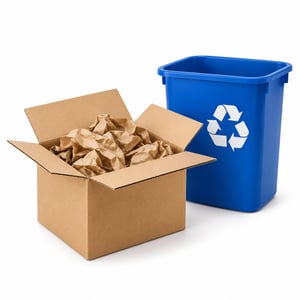
In practical terms, kerbside-recyclable void fill is protective packaging that a recipient can put into a household recycling collection rather than needing a specialist return point or disposal route. In the UK, the exact collection system still varies, so "kerbside recyclable" should never be used as a blanket claim without checking the material and the market where it will be disposed of.
The Government defines packaging as "commonly collected" when it's collected for recycling by at least 75% of local authorities across all four UK nations. Its 2026 list includes corrugated cardboard, cardboard sleeves, cereal boxes, egg boxes and several other fibre formats. The collection list is also now relevant to EPR recyclability assessments.
For operations teams, that makes the disposal instruction relatively intuitive: where a paper void fill format is suitable for the paper and card stream, the customer can usually flatten or separate it as required and recycle it alongside other fibre packaging. Always check the specific product claim and local guidance rather than assuming that anything brown and paper-looking belongs there.
Why Void Fill Matters More Than It Looks
A box can be the right size on paper and still need internal protection. Multiple products may leave irregular gaps. Fragile items need cushioning. A product that can slide from one side of a carton to the other is much more likely to experience repeated impacts during sorting and transport.
Good void fill controls that movement. Depending on the application, it can fill empty space, cushion an item, wrap a surface or create a block-and-brace arrangement that holds the contents in position. Our paper void fill range covers these different uses rather than treating paper filler as one generic product.
That distinction matters for sustainability too. The best eco-friendly void fill isn't simply the material with the most attractive environmental claim. It's the smallest, sensible amount of material that gets the product to the customer undamaged. A damaged product can mean a replacement item, another pick and pack, another shipment and more packaging. Protection is part of the sustainability calculation, not something that sits in opposition to it.
Paper Void Fill: The Most Straightforward Kerbside Route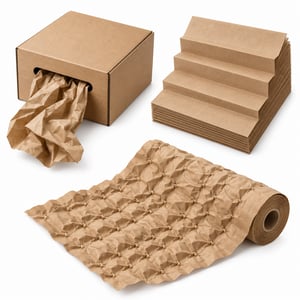
Paper packaging filler has several practical advantages for e-commerce. It's familiar to customers, available in recycled-content formats, can be supplied as manual or machine-fed systems, and works for everything from simple gap filling to heavier block-and-brace applications.
For smaller or variable-volume operations, our boxFill™ dispenser is a useful example. The paper is 100% recycled and recyclable, comes ready to dispense and doesn't require investment in machinery. Operators pull out the amount they need rather than working with fixed pre-cut lengths. That makes it a relatively easy way to introduce recyclable packing material at individual benches or across a seasonal packing area.
Higher-volume fulfilment creates a different problem. Repeatedly changing small rolls or packs can interrupt throughput, so bulk formats become more attractive. Our 100% recycled fanfold paper void fill is supplied in a high-volume pallet format compatible with many dispensing machines, reducing the frequency of loading and changeovers.
For applications where cushioning and holding power are more important, grip Premierpad paper uses a creased and crimped structure to help absorb shock and create a block-and-brace effect. The current product is made from 100% recycled paper, is FSC® certified and is described as fully recyclable.
Recyclable Doesn't Mean "Any Paper Will Do"
Paper has a well-established recycling infrastructure, but packaging design still matters. The UK's current Recyclability Assessment Methodology says paper and board packaging should consist mainly of natural fibres. Fibre-based composite packaging containing no more than 5% plastic by mass is assessed as paper and board; above that, it moves into the fibre-based composite category.
Coatings, barriers, adhesives and laminates therefore deserve attention. European paper-industry guidance makes much the same point: paper packaging can need treatments to provide functional properties, but combinations with other materials should be designed so they don't hamper the recycling process.
For ordinary void fill, keeping the construction simple has obvious appeal. If a paper filler performs without a difficult-to-separate plastic layer or unnecessary adhesive, the disposal route is easier for the customer to understand.
What About Plastic Void Fill?
Paper isn't automatically right and plastic isn't automatically wrong. Lightweight air pillows can use very little material, can be produced on demand and may offer excellent shipping protection for lightweight goods. Plastic formats can also reduce storage requirements because much of the finished cushion is air.
The difficulty has historically been the disposal route. Plastic films have not been as consistently collected at household kerbside as paper and card. That's changing in England: under Simpler Recycling, plastic film packaging and plastic bags are due to be collected with plastic recycling from households from 31 March 2027.
That's an important change, but it doesn't make every plastic void fill product identical from a recycling perspective, nor does it mean a business should wait until 2027 to review its packaging. Material type, actual collection, recycled content and the amount used all remain relevant.
Does Recyclable Void Fill Help With Plastic Packaging Tax?
Potentially, but the relationship needs to be described accurately. The UK Plastic Packaging Tax isn't a general tax on unsustainable packaging. It applies to finished plastic packaging components manufactured in or imported into the UK, with registration required where a business reaches the 10-tonne threshold. Plastic packaging components containing at least 30% recycled plastic aren't chargeable, although they still count towards the threshold and records are still required.
As of 2026, the tax rate is £228.82 per tonne for chargeable finished plastic packaging components containing less than 30% recycled plastic.
Moving from a taxable plastic void fill component to a genuinely paper-based alternative may therefore remove that component from the Plastic Packaging Tax calculation. But that doesn't automatically make the whole packaging system "tax compliant", and businesses still need to assess their own manufacturing or importing activity.
The better commercial question is broader: are you using the right material, in the right amount, with a sensible end-of-life route and evidence to support the claims you're making? Tax can be one reason to review a specification, but it shouldn't be the only one.
EPR Is Making Recyclability More Commercially Important
Extended Producer Responsibility for packaging is also changing the economics around recyclability. Under the UK system, large producers responsible for household packaging waste disposal fees must assess packaging recyclability using the Recyclability Assessment Methodology. For the 2027 reporting year, RAM 2027 will be legally required for those producers.
The intention is fairly direct: packaging that's harder to recycle can attract higher disposal costs, while the system is designed to encourage more recyclable formats. Packaging fees will be modulated from 2026/27 to create that incentive.
For e-commerce teams, this makes evidence more important. "Eco-friendly void fill" is too vague on its own. Know what the material is made from, whether it contains recycled content, what recycling stream it belongs to and what evidence the supplier can provide.
How Much Void Fill Should You Actually Use?
Before switching material, check whether you can reduce the void itself.
An oversized carton filled with recyclable paper is still an oversized carton. It uses more board, requires more filler and occupies more space through storage and transport. If the product can be shipped safely in a better-fitting outer pack, reducing the empty space is usually the first move.
This matters beyond the UK too. The EU Packaging and Packaging Waste Regulation (PPWR) has applied since 12 August 2026 and introduces further measures from 2030, including limits on unnecessary empty space and a requirement for packaging to be recyclable. The European Commission's current PPWR overview specifically highlights smaller boxes and less empty space for online deliveries.
So don't use void fill to solve a carton-sizing problem. Start with the outer packaging, then use enough protective material to control the movement that remains.
Choosing Void Fill by Product and Packing Operation
Lightweight, robust products
If the product isn't especially fragile and simply needs to be stopped from moving, a relatively small amount of paper filler may be enough. Manual dispenser systems can work well where order volumes vary or where machinery would be unnecessary.
Fragile products
Fragile items usually need more than filling empty space. Think about impact and surface protection as well. Structured cushioning paper can create a stronger block-and-brace arrangement, while wrapping formats can protect individual surfaces before the remaining void is filled.
Our grip® Paperflex wrapping paper is made from 100% recycled kraft paper and expands into an interlocking structure around the product. It's intended as a recyclable alternative to conventional bubble wrap and can reduce the need for separate tape around the wrapped item.
High-volume e-commerce
Once hundreds or thousands of parcels are moving through the same packing area, the consumable is only part of the decision. Loading frequency, dispenser position, operator movement and packing speed begin to matter much more. Our PAPERplus® range includes machine-produced paper cushioning systems for operations that need protective paper generated at the workstation.
The point isn't that every growing operation needs machinery. Quite often it doesn't. A machine starts to make sense when the manual process is repetitive enough that throughput, consistency or labour justify the additional equipment. Until then, a simple dispenser can be the more sensible system.
Don't Confuse Recycled, Recyclable and Responsibly Sourced
These claims answer different questions.
A product can contain recycled material but still be difficult to recycle. A recyclable product can be made from virgin fibre. FSC® certification concerns responsible forest-based sourcing and chain of custody; it isn't, by itself, a recyclability certification.
For procurement teams comparing sustainable packaging materials, it helps to record these attributes separately: recycled content, recyclability, collection route, certified sourcing where relevant, material weight and the amount needed per shipment. That gives you something more useful than a single green tick next to "sustainable".
How to Compare the Real Cost of Void Fill
Cost per roll or box is only the starting point.
Two paper fillers can have very different yield once they are crumpled, expanded or converted into pads. One might be cheaper per metre but require substantially more material per parcel. Another might cost more as a consumable but reduce packing time.
For a useful comparison, measure the cost per successfully shipped order. Include the amount of void fill used, operator time, storage footprint, dispenser or machine cost where relevant, replenishment time and damage rates.
Then test it with real products. Packing trials are much more useful than comparing specification sheets in isolation. If a new material saves 4p per order but produces more damaged shipments, the saving wasn't real. If a more expensive paper format lets an operator use less material and pack faster, the headline price may be misleading in the opposite direction.
A Practical Checklist for Choosing Kerbside-Recyclable Void Fill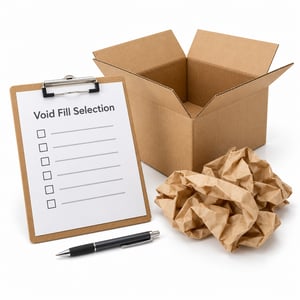
- What movement or impact are we trying to control?
- Can we reduce the empty space by changing the carton first?
- Is the material accepted through an established household recycling stream in the markets we serve?
- Is the recyclability claim for the complete format, including coatings, films or adhesives?
- How much recycled content does it contain?
- Do we need FSC® or other sourcing evidence for fibre-based material?
- How much material is actually required per order?
- Can operators use it consistently without slowing the packing line?
- How much storage space does the consumable require?
- Would a manual dispenser, semi-automatic system or machine-fed format suit our volume?
- How does the specification affect Plastic Packaging Tax or EPR reporting, where those regimes apply to us?
- What happens to damage rates after the change?
If you can answer those questions, you're in a much better position to compare recyclable packing material on performance rather than simply choosing whichever product carries the strongest environmental wording.
Recyclable Void Fill Should Still Protect the Shipment
There is a temptation to treat the move towards recyclable packaging as a material substitution exercise: remove plastic, insert paper, job done. In reality, the better approach is to look at the complete pack.
Right-size the carton. Work out where movement occurs. Choose a filler or cushioning format that deals with that problem using a sensible amount of material. Make sure the customer has a realistic disposal route. Then measure what happens to packing time, material consumption and damage.
For many e-commerce operations, kerbside-recyclable paper void fill ticks a lot of those boxes. It's familiar, versatile and available in formats ranging from simple bench-top dispensers to high-volume machine systems. But there will still be applications where another material or protection method makes more sense.
That's why our approach isn't simply to replace one material with another. Our void fill range includes different protection formats for different products and packing environments, while our sustainable packaging range brings together recyclable, recycled-content and lower-impact options across the wider pack.
Need Help Choosing the Right Void Fill?
If you're reviewing void fill for recyclability, cost, packing efficiency or product protection, our team can help you compare the options against the way you actually pack and ship. From manual paper systems to higher-volume cushioning solutions, we'll help you find a specification that protects the product without adding material or complexity you don't need. Contact us to discuss your packaging requirements.