
For a small ecommerce business, sustainable packaging decisions rarely happen in ideal conditions. The packaging still has to protect the order, fit into a limited storage area, arrive in quantities the business can afford to hold and work efficiently at the packing bench. A material can look attractive on a sustainability checklist and still be the wrong choice if it increases damage, slows fulfilment or leaves months of cash sitting in unused stock.
That makes sustainable packaging less about finding a single 'greenest' material and more about choosing a packaging system that uses resources deliberately. In 2026, UK SMEs also have to make those decisions against a changing regulatory background, from extended producer responsibility (EPR) to Plastic Packaging Tax and the expansion of household plastic-film collections in England from March 2027.
Our sustainable packaging range reflects that broader approach, covering fibre-based and recycled-content options alongside packaging designed around recovery, reuse and practical performance. For SMEs, however, the best place to begin is not the material. It is the order being shipped.
1. Start With the Product, Not the Packaging Claim
Before deciding that a pack should be plastic-free, recyclable, reusable or made with recycled content, establish what it actually has to do. A lightweight garment, a bottle of skincare product and a ceramic subscription-box item have very different protection requirements. The packaging should reflect those differences.
Consider weight, fragility, moisture sensitivity, surface finish, product value and the likely distribution journey. A parcel travelling through a carrier network may experience drops, compression and repeated handling that are absent from a product collected directly by a customer. If reducing material causes the damage rate to rise, the apparent saving is unlikely to survive contact with the real supply chain.
This is also why plastic shouldn't be treated as automatically wrong. Fibre-based alternatives can be excellent where they provide the required protection and a practical end-of-life route. Plastic can still be the more appropriate material where moisture resistance, low weight, flexibility or repeated use matters. The objective is to remove unnecessary material and choose the most appropriate specification for the job, rather than simply swapping one material for another because its sustainability story is easier to communicate.
2. What Counts as Sustainable Packaging in Practice?
Terms such as eco-friendly packaging materials, recyclable packaging, recycled packaging and plastic-free packaging are often grouped together, but they describe different characteristics. A carton can contain recycled fibre without being the best size for the product. A plastic mailer can contain recycled content while still being a single-use item. A paper alternative may be widely recyclable but require more material to deliver equivalent protection.
For an SME, a useful assessment looks at the whole packaging lifecycle: how much material is used, where it comes from, how efficiently the pack performs, whether the customer can realistically recycle or reuse it, and whether the specification creates avoidable waste elsewhere in the operation.
Where fibre sourcing matters, look for products that are specifically identified as FSC® certified rather than assuming every paper or cardboard product carries certification. We only describe products as FSC® certified where they're specifically identified as such on our website.
3. Stock Packaging or Bespoke Cartons? SMEs Need Both Options

Bespoke packaging is often presented as the natural end point of packaging optimisation, but it is not automatically the right starting point for a smaller ecommerce business. Standard stock cartons and mailers have a major advantage: they are available without committing cash to a large custom production run and can be useful when order profiles are still changing.
Thankfully, our ecommerce packaging range gives SMEs access to established formats for common fulfilment requirements, while its e-commerce boxes provide a useful example of a stock format designed around ecommerce use. The Durabox™ ecommerce boxes listed by Allpack include an integral seal strip and ripper, removing the need for separate tape during normal packing and potentially simplifying fulfilment.
Bespoke cartons become more compelling when order patterns are predictable enough to justify them. If one product or subscription configuration accounts for a large share of monthly shipments, a better-fitting pack may reduce corrugated material, void fill and packing steps at the same time.
The important SME question isn't 'Is bespoke better?' It's 'Is our demand stable and concentrated enough for the benefits to outweigh the commitment?' A growing business with rapidly changing products may value flexibility more than perfect dimensional optimisation. A mature subscription business shipping 5,000 near-identical boxes each month has a very different calculation.
4. MOQ Is a Sustainability Issue When Cash and Space Are Limited
Minimum order quantity is normally discussed as a purchasing term. For a smaller operation, it is also part of the packaging decision itself.
A lower unit price can become expensive when the order quantity ties up cash that could be used elsewhere in the business. It can also occupy pallet positions or shelving for months. If branding, product dimensions or customer requirements change before the stock is consumed, the business may be left with obsolete packaging.
Compare suppliers and specifications using the amount of stock you realistically expect to consume, not the headline unit price at the largest available quantity. Ask how much cash will be committed, how many weeks or months of demand the order represents, and where the packaging will physically live.
For many SMEs, paying slightly more per unit for a sensible replenishment quantity can actually be cheaper overall than purchasing a year's supply just to reach an attractive price break.
5. Subscription Boxes Need Forecasting Before They Need Fancy Packaging
Ecommerce subscription box packaging deserves particular attention because recurring orders make demand more predictable, but they can also encourage businesses to commit to large, branded packaging runs too early.
Start with the subscription forecast. How many active subscribers are there? What is the expected churn rate? Is the product mix stable? Will seasonal editions require different dimensions? How much safety stock is genuinely necessary?
A simple forecast based on active subscribers, expected additions and cancellations can establish a more realistic packaging requirement. Add a controlled buffer for damage, sampling and demand variation rather than ordering against an optimistic growth target.
Repeatable subscription profiles can eventually make bespoke packaging highly effective because the same dimensions recur every month. Before reaching that point, stock ecommerce cartons can preserve flexibility and reduce the risk of being left with packaging designed for a product mix that no longer exists.
6. Plastic-Free Packaging Alternatives: Where Do They Work Best?

There are now practical plastic-free packaging alternatives for many common ecommerce applications. The important part is matching them to the job rather than treating 'plastic-free' as a performance specification in its own right.
Paper mailing and padded formats
For soft goods and other suitable products, paper mailing bags can replace conventional plastic mailing formats in applications where the required strength and moisture performance are appropriate. For products needing more protection, we also offer paper fluted envelopes and paper bubble mailers as fibre-based mailing options.
Paper tape
Cartons can also be closed using kraft paper hand tapes where the tape specification is suitable for the carton, load and distribution environment. For an SME trying to simplify the customer's disposal experience, reducing mixed materials can be useful, but sealing performance still comes first.
Paper void fill
Where products need blocking, bracing or cushioning within a carton, paper void fill solutions provide a fibre-based alternative to several conventional plastic void-fill formats. The more important question, however, is whether the void exists because the carton is too large. Right-sizing should be considered before simply changing the material used to fill the gap.
When plastic still makes sense
Some ecommerce products need moisture resistance, puncture resistance or low-weight flexible protection that is difficult to reproduce efficiently with fibre alone. In those cases, a plastic format with appropriate recycled content or a design that uses less material may be a more credible improvement than forcing a plastic-free substitute into the application.
Sustainable packaging should survive the real world. A damaged product, replacement shipment and second set of packaging can erase the benefit of a material reduction very quickly.
7. Rationalise Packaging SKUs Before Adding More Sustainable Ones
A common SME packaging problem is accumulation. One carton was introduced for a product launch, another for Christmas orders, a third for a marketplace requirement and several more because somebody found a good price. The result is a packing area containing multiple formats that perform almost the same job.
Before adding a new sustainable packaging SKU, review what is already being used. Group packaging by function and dimensions, identify low-volume duplicates and look for specifications that can cover more than one order profile without creating excessive empty space.
Fewer SKUs can mean less cash tied up in packaging, simpler stock counts, easier replenishment and less storage. It can also make training easier when temporary staff join during peak periods.
There is a limit. Removing carton sizes purely to reduce SKU count can push small products into oversized boxes, increasing both corrugated and void-fill consumption. Rationalisation should remove unnecessary choice, not useful dimensional variety.
8. Calculate the Real Cost per Successfully Shipped Order
The cheapest packaging component is not necessarily the most cost-effective packaging for SMEs. A better measure is the cost of getting an order to the customer successfully.
Include the outer pack, tape, labels and protective material, but continue beyond them. How long does the order take to pack? How much storage does the packaging require? Does the chosen format increase carrier dimensions? What percentage of orders are damaged or repacked? How much packaging is wasted because an operator uses inconsistent quantities?
This matters when comparing sustainable alternatives. A paper solution costing several pence more may still be commercially attractive if it simplifies the pack or reduces another material. Conversely, an apparently cheap carton may be expensive if its dimensions require large quantities of void fill and increase packing time.
For SMEs, the most useful calculation is often not cost per box. It's cost per successfully shipped order.
9. When Packaging Machinery Is Premature
Automation can reduce labour and improve consistency, but smaller ecommerce operations should be wary of buying machinery simply because manual packing feels unsophisticated.
If volumes are low or product formats change frequently, a machine can introduce capital cost, maintenance, floor-space requirements and a dependency on a process that has not yet stabilised. The business may gain more from a better bench layout, simple dispensers, clearer packaging specifications and fewer unnecessary SKUs.
Automation becomes more interesting when a repetitive task consumes enough labour to create a measurable bottleneck. Until then, flexibility has value. A manual process that can switch between five products quickly may be economically better than a faster automated process that requires frequent changeovers.
For a growing SME, the right question is not 'When should we automate?' but 'Which repetitive constraint has become expensive enough to justify automation?' Measure first and invest afterwards.
10. Compliance: Keep It Proportionate and Know Which Rules Apply
Sustainable packaging decisions increasingly overlap with regulation, but an SME shouldn't assume that every packaging rule applies simply because the business is small, sells online or uses a particular material. The thresholds and responsibilities differ.
Extended Producer Responsibility (EPR)
UK EPR obligations depend on turnover, packaging tonnage and the activities the organisation carries out. Under current government guidance, organisations with turnover of £1 million or less have no EPR obligation under the threshold table. Businesses above £1 million that supply more than 25 tonnes of packaging can fall within the small-producer regime, while organisations with turnover above £2 million and more than 50 tonnes can be classed as large producers. 'Small producer' is therefore a regulatory category, not simply another term for SME.
For an ecommerce business approaching those thresholds, packaging data should become part of procurement discipline. Knowing material types and weights is useful operationally even before a formal reporting requirement applies.
Plastic Packaging Tax
Plastic Packaging Tax is narrower. In 2026, businesses generally need to register if they manufacture or import 10 tonnes or more of finished plastic packaging components within the relevant period. The tax applies to chargeable components containing less than 30% recycled plastic and is £228.82 per tonne from 1 April 2026. Buying plastic packaging from a UK supplier is not, by itself, the same as manufacturing or importing it.
That distinction matters for SMEs. The existence of the tax is a reason to understand recycled content and supplier documentation, but it shouldn't be presented as a direct tax liability for every ecommerce business using a plastic mailer.
Simpler Recycling and plastic film in 2027
In England, plastic film packaging and plastic bags are due to be collected with household plastic recycling from 31 March 2027. This improves the practical end-of-life context for some flexible plastic packaging, although recyclability still depends on the specific material and collection/reprocessing system. It's another reason not to treat all plastic packaging as one undifferentiated category.
11. How to Compare UK Packaging Suppliers
Choosing between UK packaging suppliers should involve more than sending the same product list to several companies and selecting the lowest quote. For an SME, supplier behaviour can influence how much stock and risk the business has to carry itself.
Ask about realistic MOQs, lead times, stock availability and what happens when demand rises unexpectedly. Check whether the supplier can cover several packaging categories, because supplier consolidation can reduce purchasing administration and delivery complexity. At the same time, avoid consolidating purely for convenience if a specialist supplier is materially better at a critical requirement.
Technical support matters as the business grows. Can the supplier help reduce material use, review carton dimensions or investigate recurring transit damage? Can it support a move from stock packaging to bespoke specifications when volumes justify it?
Environmental claims should also be specific. Ask what recycled content is documented, which products are actually FSC® certified, what the likely disposal route is and whether claims apply to the complete pack or only one component.
Allpack brings together a broad ecommerce packaging range with dedicated sustainable packaging options, giving growing businesses scope to review several parts of the pack without assuming that one material or format will suit every order.
12. A Practical Sustainable Packaging Framework for SMEs
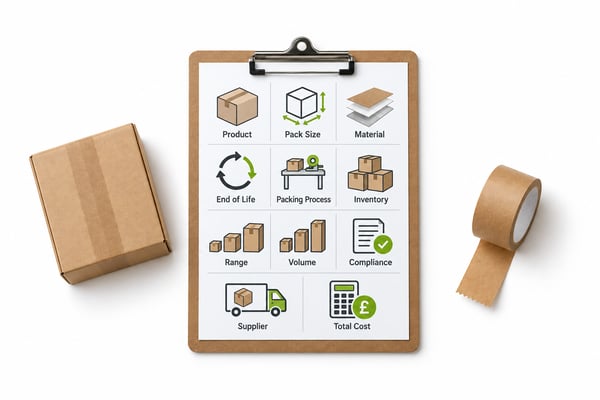
When comparing packaging options, work through the decision in this order:
- Product: What must be protected, and from what?
- Pack size: What is the smallest practical format that accommodates the product and necessary protection?
- Material: Which options can provide the required performance with the least unnecessary material?
- End of life: Can the customer realistically reuse or recycle the packaging?
- Packing process: How long does it take to assemble, fill and close?
- Inventory: What MOQ, storage space and cash commitment does the specification create?
- Range: Does it replace an existing SKU, or simply add another one?
- Volume: Is demand predictable enough to justify bespoke packaging or machinery?
- Compliance: Which EPR, Plastic Packaging Tax or other obligations actually apply to the business?
- Supplier: Can the supplier provide evidence, continuity and practical support as requirements change?
- Total cost: What does the packaging cost per successfully delivered order, not merely per unit?
Sustainable Packaging Has to Work for the Business Too
For SMEs, sustainability can't be separated from commercial reality. Packaging that requires an unaffordable MOQ, consumes scarce storage space or slows every order is unlikely to remain a good solution for long. Equally, choosing the cheapest available pack can create costs through wasted material, damage and inefficient fulfilment.
The strongest approach is usually incremental. Remove packaging you don't need. Right-size where order patterns justify it. Rationalise overlapping SKUs. Introduce plastic-free alternatives where they perform well, and use recycled-content plastic where plastic remains the practical choice. Move towards bespoke formats and automation when volume makes the economics credible, not simply because the business has grown enough to feel that it should.
That is what cost-effective sustainable packaging looks like in practice: fewer assumptions, better information and packaging choices that continue to make sense after the parcel leaves the packing bench.
Ready to review your packaging?
Whether you are looking to reduce material use, simplify your packaging range or find more sustainable options for ecommerce fulfilment, Allpack can help you identify solutions that balance protection, practicality and cost. Contact our team to discuss your packaging requirements, call 01543 396 700 or email sales@allpack.uk.com.